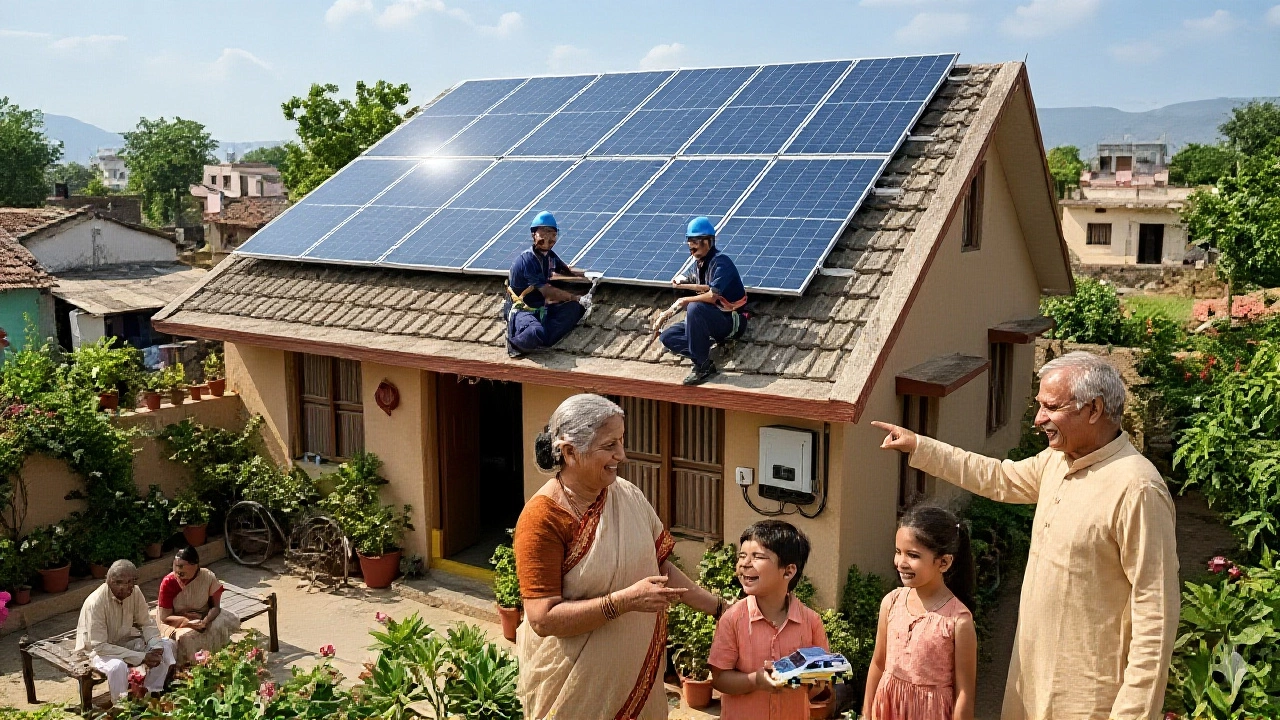
When Narendra Modi, Prime Minister of India, launched the PM Surya Ghar: Muft Bijli YojanaNew Delhi in July 2024, he didn't just announce another government scheme. He unveiled what officials are calling the world's largest residential rooftop solar program. The goal is ambitious: install solar panels on over 1 crore (10 million) homes across India by March 2027.
Here’s the thing that makes this different from previous green energy initiatives. It’s not about massive solar farms in remote deserts. This plan puts power generation directly on your roof. Households can generate up to 300 units of electricity for free every month, drastically cutting—or even eliminating—their monthly bills. For a country where rising energy costs squeeze middle-class budgets, that’s a game-changer.
The Numbers Behind the Sun
The scale of this project is staggering. According to the Press Information Bureau, the government has set aggressive milestones. By March 2025, they aim for 1 million installations. That number doubles to 2 million by October 2025, hits 4 million by March 2026, and finally reaches the 10 million target by March 2027.
Turns out, the momentum is already building. Recent data shows over 626,900 applications have been submitted so far. Approximately 248,500 solar systems are installed, covering more than 308,200 homes. These installations are currently generating over 9,000 megawatts of power. To put that in perspective, that’s enough electricity to power hundreds of thousands of households simultaneously. The government has already disbursed roughly ₹17,682 crore ($2.1 billion) in subsidies.
How Much Money Are You Saving?
Let’s talk cash. The financial incentive is the hook that’s getting people interested. Under the scheme, the government provides direct benefit transfers to homeowners’ bank accounts. Here’s the breakdown:
- Up to 2 kW system: 60% subsidy
- 3 kW system: 40% subsidy
- Maximum Cap: ₹78,000 (approx. $930) per household
If you install a 2 kW or larger system, you can generate an average of 300 units of electricity monthly. For many families, this means saving between ₹1,500 and ₹1,800 ($18–$22) on their monthly bill. Over the 25-year lifespan of solar panels, those savings add up to lakhs of rupees. Plus, there’s an environmental bonus: each home reduces its carbon dioxide emissions by about 1.5 tons annually.
But wait, what if you can’t afford the upfront cost? The government has partnered with banks to offer collateral-free loans at interest rates as low as 7%. It’s designed to make solar accessible even if you don’t have the cash on hand today.
Who Qualifies and How to Apply?
The eligibility criteria are straightforward but strict. You must be an Indian citizen with a valid domestic electricity connection in your name. Crucially, you need to own the house or have permission to install panels on the roof. If you’ve already benefited from other solar subsidy schemes, you’re out of luck—this is a one-time offer per household.
The application process is entirely digital, which is a smart move for reducing bureaucracy. Homeowners visit the official portal, enter their state, electricity board details, and consumer number. They then select an approved vendor—companies like Bluebird Solar are among the certified partners. After a site inspection and installation, a net meter is fitted. Once all paperwork is uploaded and verified, the subsidy hits your bank account directly.
State-Level Impact: The Uttar Pradesh Example
While this is a national scheme, its success depends on state-level execution. Uttar Pradesh is leading the charge. The state government has collaborated closely with New Delhi to streamline approvals through local DISCOMs (Distribution Companies). Reports from UP highlight rapid adoption rates, suggesting that when states prioritize the initiative, the numbers jump significantly.
This partnership model is key. The central government provides the funding and policy framework, while states handle the ground-level logistics. It’s a test case for how federal nations can drive large-scale renewable energy transitions without stifling local autonomy.
Why This Matters Beyond the Bill
Oddly enough, the biggest impact might not be on your wallet, but on India’s grid stability. With summer temperatures soaring above 45°C (113°F) in recent years, demand peaks strain the national grid. Distributed rooftop solar reduces load during peak hours, preventing blackouts and reducing the need for expensive peaker plants.
Furthermore, this aligns with India’s commitment to reach Net-Zero emissions by 2070. Adding 30 gigawatts of additional solar capacity isn’t just a nice-to-have; it’s essential for meeting international climate goals. Every panel installed is a step away from fossil fuels.
Frequently Asked Questions
What is the maximum subsidy I can get under PM Surya Ghar?
The maximum subsidy available is ₹78,000. This applies to systems up to 3 kW. For smaller systems up to 2 kW, you receive 60% of the cost covered, while 3 kW systems get 40% coverage. The amount is transferred directly to your bank account after installation verification.
Do I need to own my home to apply?
Yes, ownership or explicit permission is required. The electricity connection must be in your name, and you must have the legal right to install structures on the roof. Renters typically cannot apply unless they have written consent from the landlord and meet specific criteria set by local DISCOMs.
How much electricity can a typical home generate?
A standard 2 kW to 3 kW rooftop system can generate approximately 300 units of electricity per month on average. This covers most of the consumption for a typical urban household, potentially making your monthly bill zero or very low depending on usage patterns.
Is there a loan option for those who can't pay upfront?
Yes, the scheme facilitates collateral-free loans at subsidized interest rates starting around 7%. This allows households to install systems without paying the full capital cost immediately, spreading the expense over time while still benefiting from reduced electricity bills.
What happens to excess electricity generated?
Through net metering, any excess electricity generated by your panels is fed back into the grid. Your meter runs backward, crediting your account. These credits can offset consumption during nights or cloudy days, ensuring you maximize the value of your solar investment.